NPE Statement on Charter Schools

Network for Public Education

 Statement on Charter Schools

The Network for Public Education believes that public education is the pillar of our democracy. We believe in the common school envisioned by Horace Mann. A common school is a public institution, which nurtures and teaches all who live within its boundaries, regardless of race, ethnicity, creed, sexual preference or learning ability. All may enroll–regardless of when they seek to enter the school or where they were educated before.

We believe that taxpayers bear the responsibility for funding those schools and that funding should be ample and equitable to address the needs of the served community. We also believe that taxpayers have the right to examine how schools use tax dollars to educate children.

Most importantly, we believe that such schools should be accountable to the community they serve, and that community residents have the right and responsibility to elect those who govern the school. Citizens also have the right to insist that schooling be done in a manner that best serves the needs of all children.

By definition, a charter school is not a public school Charter schools are formed when a private organization contracts with a government authorizer to open and run a school. Charters are managed by private boards, often with no connection to the community they serve. The boards of many leading charter chains are populated by billionaires who often live far away from the schools they govern.

Through lotteries, recruitment and restrictive entrance policies, charters do not serve all children. The public cannot review income and expenditures in detail. Many are for profit entities or non-profits that farm out management to for-profit corporations that operate behind a wall of secrecy. This results in scandal, fraud, and abuse of taxpayer funds. The news is replete with stories of self-dealing, conflicts of interest, and theft occurring in charter schools [1].

We have learned during the 25 years in which charters have been in existence that the overall academic performance of students in charter schools is no better, and often worse, than the performance of students in public schools. And yet charter schools are seen as the remedy when public schools are closed based on unfair letter-based grading schemes.

By means of school closures and failed takeover practices like the Achievement School District, disadvantaged communities lose their public schools to charter schools. Not only do such communities lose the school, but they also lose their voice in school governance.

There is little that is innovative or new that charter schools offer. Because of their “freedom” from regulations, allegedly to promote innovation, scandals involving the finances and governance of charter schools occur on a weekly basis. Charter schools can and have closed at will, leaving families stranded. Profiteers with no educational expertise have seized the opportunity to open charter schools and use those schools for self-enrichment. States with weak charter laws encourage nepotism, profiteering by politicians, and worse.

For all of the reasons above and more, the Network for Public Education regard charter schools as a failed experiment that our organization cannot support. If the strength of charter schools is the freedom to innovate, then that same freedom can be offered to public schools by the district of the state.

At the same time, we recognize that many families have come to depend on charter schools and that many charter school teachers are dedicated professionals who serve their students well. It is also true that some charter schools are successful. We do not, therefore, call for the immediate closure of all charter schools, but rather we advocate for their eventual absorption into the public school system. We look forward to the day when charter schools are governed not by private boards, but by those elected by the community, at the district, city or county level.

Until that time, we support all legislation and regulation that will make charters better learning environments for students and more accountable to the taxpayers who fund them. Such legislation would include the following:

·     An immediate moratorium on the creation of new charter schools, including no replication or expansion of existing charter schools

·     The transformation of for-profit charters to non-profit charters

·     The transformation of for-profit management organizations to non-profit management organizations

·     All due process rights for charter students that are afforded public school students, in all matters of discipline

·     Required certification of all school teaching and administrative staff

·     Complete transparency in all expenditures and income

·     Requirements that student bodies reflect the demographics of the served community

·     Open meetings of the board of directors, posted at least 2 weeks prior on the charter’s website

·     Annual audits available to the public

·     Requirements to following bidding laws and regulations

·     Requirements that all properties owned by the charter school become the property of the local public school if the charter closes

·     Requirements that all charter facilities meet building codes

·     Requirements that charters offer free or reduced priced lunch programs for students

·     Full compensation from the state for all expenditures incurred when a student leaves the public school to attend a charter

·     Authorization, oversight and renewal of charters transferred to the local district in which they are located

·     A rejection of all ALEC legislation regarding charter schools that advocates for less transparency, less accountability, and the removal of requirements for teacher certification.

Until charter schools become true public schools, the Network for Public Education will continue to consider them to be private schools that take public funding.

——
The Network for Public Education is a 501 (c)(3) organization. You can make a tax deductible donation here.

You can follow us on twitter and like us on Facebook.

Relationships and the Company We Keep.

There are two basic principles that I think as a field, psychologists and learning theorist’s agree upon: The importance of relationships, and that we learn to be like those in whose company we grow up in (and want to be like).

In fact, a 32-year longitudinal study, with about 1000 participants, found that social connectedness was a better predictor of well-being than academic achievement. (http://dro.deakin.edu.au/view/DU:30046123)

caring

By learning I am not really referring to the remembrance of facts (though, even the remembering of facts depends upon the context of the above factors). There are studies that when they control for (which means do not take into account) all other factors find certain methodologies to be more effective than others—how many repetitions, the order presented, levels of mastery, and so forth. However, to me, what really a matters when we look at the big picture of schooling and learning, is what kind of people we become, what we care about, what is our attitudes toward others, toward learning, and toward the society we live in, and as importantly, how we view ourselves.

If we start with these, relationships and the company we keep as our basic principles of learning, then the design of our school, classroom, learning environment need to reflect that. In other words, do the designs of the above, hinder or support strong relationships and creating a context for students to be surrounded by the kinds of people that we hope they become?

One aspect of creating this environment is thinking about the time and space for all members of the learning community to get to know each other. One factor is class size ratios. With too large class sizes (or numbers of students a teacher has on their total class load), teachers cannot get to know their students (and their families) well. In California, with class sizes often around 30, (and for high school teachers, multiply that by 4, 5 or 6 as they teach multiple groups of students).  I argue that such large classes make strong relationships difficult. Half that, or maybe two adults in the room (or both) would make it more realistic.

I also recommend that students stay with teachers for more than one year. From my personal experience teaching, both having times when I had my students for only one year, and others where I had them for two or even three years, I found I was able to develop much deeper relationships in the second year. It also allowed for a sense of trust of giving students time to grow. (There are also many other advantages to multi-graded classrooms and keeping students for multiple years, for that you can read this previous blog).

School size also matters. The relationship built are more than just within the classroom. The school itself needs to be a community, with all the members having relationships with each other. This matters in part because students do move from teachers to teacher. It also matters because students see what kinds of relationships the adults around them have. They learn as much from watching others as they do form their direct experiences. They learn what it means to be an adult by watching adultas The teachers, and staff of a school are the adults in a working, non-family role that they see most, and most intimately.

However, the curriculum also has an effect. If the teacher’s job is to either be in front lecturing, or monitoring students doing worksheets, neither of these behaviors are likely to foster meaningful relationships no matter what the class size. Curriculum that allows the participants to share their ideas, work together and be creative are more likely to foster relationships. Curriculum that allows the teacher to tailor the the learning to the child/ren, to what is happening in the moment, also fosters relationships, caring.

Besides what goes on in the classroom is the larger learning community. In the majority of school’s children are told their job is to do what the teacher says, who in turn does what that principal says, who in turn does what the school board says, who in turn does what the State mandates. This is the company children keep during probably the majority of their non-family time—the time that represents larger society, a place that they are required by society to be.

If we want students to learn to be people who understand how a democratic society works, and how people who can make decisions over their lives and society act, then the adult in the learning community need to be doing such things. That means the way the school itself runs should be a place where the adults make the important decisions over what goes on in that community—the schedule, the work environment, and how the teaching and learning is structured. If the adults in the schools are mainly following orders from above, then that is what children will learn. They may want to reject that social order, to rebel against it, but the will not be learning how to do so effectively. Or they may reject it by just wanting to be the one’s who are on top, but again not seeing an alternative to the top down model of governance.

In sum, if we want to have healthy well educated students who know what it means to be a citizen of a democratic society, then the schools they grow up in need to reflect such a world, and they need the ability to build meaningful relationships with the adults and each other in those schools. Those adults need to be able to act that students would want to be adults like them.

Should we still require cursive?

I just came across a piece entitled Ten Reasons People Still Need Cursive by Jennifer Doverspike, in the Federalist. The piece is obviously on the importance of teaching cursive. As one who found its imposition on me as an elementary student to get in my way, rather than help me (and in fact, my teachers in middle school were glad when I quit using it, since they found it difficult to read my cursive), I decided to critique the 10 claims.

cursive

  1. Cursive Helps People Integrate Knowledge

So do lots of other things at least as well, such as the arts, theater, physical education, all of which there is way too little of in most public schools. These others sound like better and more interesting ways to integrate knowledge to me. And print is just as tactile as cursive, so would it not do this integration just as well?

  1. Writing Long-form Teaches Us How to Write

The author cites a correlation between the good writing and good handwriting in children. However, it may be that those that have good handwriting as children do so simply because they have matured earlier, both physically and mentally—so do not confuse correlation with causation. I would have to see evidence of such a correlation in adults to give it any credit. If you want fast, then learn to type—that is what I did, since I have atrocious handwriting.

  1. Our Hands Should Be Multilingual

“Should be?” Well, there are lots and lots of things maybe we should be—like be multilingual. Is its more important than all the other things that time could be spent on. Remember, time is school is an extremely limited resource. I do not see a reason to force this one particular “should” over all the others I can think of that we do not find time for in school.

  1. We Learn Better When We Write It Down

We can write it down without knowing cursive. In argument 2, they focus on the need for speed in writing, yet in this argument they argue slow is better. Well then go to print. And what the author is referring to writing down is lecture notes. Children rarely do have to do this, and a better way to learn is to be actively doing something rather than listening to lectures anyway.

  1. Handwriting Leads to Cognitive Development, Self-Esteem, and Academic Success

It may only do so because we give it that importance. And in fact, since good handwriting is easier for some, requiring it actually gives an academic advantage to those who have better dexterity, but may not be any smarter. Again from the research cited, they may very well be confusing correlation with causation, or even reversing the cause-effect relationship.

  1. It May Help Those With Special Needs

And it may hurt them too. That it “may” is not a reason to impose it on all. For many using a keyboard opens up a world denied to them, especially students with physical impairments which make handwriting more difficult. If it helps a particular student, great, but this is a sweeping generalization.

  1. It Reduces Distractions and Inspires Creativity

Maybe it does for some, and for others it becomes another burden—I know that when I started typing (in middle school) and then using a computer (in college), it was way less frustrating for me, and in each case I felt more creative, not less. I do not think I am all that unique in that way.

  1. It Keeps Our Brains Active in Old Age

There are millions of ways to keep one’s brain active in old age. It does not happen to be the one I would choose. If you like it great—but do not impose it on me.

  1. We Need to Be Able to Read Cursive

Actually, I have found extremely few times in my adult life when I need to read cursive—and the claim you need to be able to write it to read it is just plain false.  If and when such a time comes up, one can learn it. There is no critical age for learning to read or write cursive. Learning to read it can be done in a tiny fraction of the time needed to learn to write it. To force all to learn to write cursive for the few that might find it necessary seems wasteful and arbitrary.

  1. We Can Create Something Beautiful and Unique.

Again, there are millions of way to create unique and beautiful things. To impose this one way is arbitrary. I would hate it to be imposed on me.

My main argument is not that cursive is bad—but it is no longer necessary in modern society. I could make 10 easily as justifiable arguments for learning to ride a horse , but we do not require horse back riding or many other wonderful things that can integrate our brains and help us be creative. All of the arguments relate to why it may be worth doing, but do not justify it as a requirement, especially given the limited time that schools have with children.

As a teacher I happened to have liked teaching cursive—but that was because I could keep the kids busy and quiet at the end of a long day in a mindless activity that as third graders they saw as important. Learning cursive was, and may still be a sort of right-of-passage. That is the best argument I can come up with to teach it.


Heroes

In this post I am going to discuss a pet peeve about the use of language–the use of a particular word. I am an avid tennis player (even if not particularly good). I get the magazine Tennis, and there was an article asking some tennis stars who their heroes were. The large majority of them named tennis or other sport stars from the past. I have found this use of the term hero to be quite common.

humptydumpty with quote

What is a hero? We can go to the dictionary, but that is problematic in that a) the dictionary offers several definitions, and b) dictionaries are not the arbitrators of definitions but the recorders of them—dictionaries decide definitions by their usage. My experience has been that the word hero is often used the way I described above.

However, for me, that use of hero is simply a synonym for idol. What I would like to reserve the term hero for when it includes two other criteria besides (and some dictionary definitions do include these, especially if you look up heroism, or heroic, rather than just hero). These are that it is done in the service of others, and that some risk is taken.

While I admire Roger Federer as a tennis player, and he may even be an idol or someone I want to be like as a tennis player, he does not fit my definition of a hero. His becoming one of the best tennis players ever took and takes an enormous amount of dedication and talent. But he did not take any what I would call significant risks—his life or future was not put in danger by his working to be a great tennis player. He did it for himself—no one is saved by his great tennis playing.

I see this phenomena of people naming idols—often media and sports stars—as common, true from kids to adults. I wonder if this is just a different idea of what hero means, or part of out focus on media and sports stars in our culture.

One common answer kids, and others often give, though, does fit my definition. Parents! Parents do fit the hero definition of mine! Having a child is a big risk—no one really comes prepared for what it means to be a parent. It is a big sacrifice! The work of a parent is to put one’s child before oneself.

Do you have a pet peeve about a word you feel is misused? What is it and why?

Multi-graded Classroom

We think of the age-graded classroom as so normal, as if it is just the natural order of things—and forget that it is a relatively recent modern invention.

zits

The first public schools were mostly small one room buildings with kids of all ages and a teacher. This was mostly done not out of any belief in multi-aged classroom, but since most people lived in rural areas, schools were not likely to have more than a classroom full of kids from the town and surrounding farms, and their attendance often sporadic.

The age-graded classroom was a product of two simultaneous and connected changes in society: urbanization and industrialization. In a primarily agricultural society, there were too few students in close enough proximity to fill up more than a class or two, especially given that most did not spend much time in school. Most of what anyone needed to know could be, and really had to be, learned at home on the farm. Basic reading, writing, and arithmetic were all that was needed from school for most people, and not to a very sophisticated level.

Urbanization meant more of the population was living in larger cities, which meant schools could have larger enrollments. With more of the population living in large cities, now in many places there were enough children of one age to make a entire class or even more than one. It also meant more people’s jobs were working for someone else, and so schooling seemed more important as well. Further, since parents were working outside the home, they needed a place to send their kids.

Industrialization brought with it as well the idea of assembly line efficiency. It only made sense to apply the modern ideas of such efficiency to the classroom, especially given having so many children in one place. Curriculum was designed along these lines, where all teachers could give the same lessons to all the kids of a certain age in the proper order.

Soon this way of doing things, where students were grouped by age and taught subjects and content in a linear order, became what seemed the natural order of things. Multi-graded classrooms were now just an inconvenience of the few places left rural enough not to be able to have age-graded classrooms, or in larger schools to avoid hiring extra teachers when the numbers did not work out to have a complete class at every grade, putting the extra kids form two grades together.

When most teachers are now assigned such a combination grade class they dread it. After all, it is gong to mean two different curricula they have to teach; kids of different ages to manage; more different groups. How to instruct one group while keeping the other busy doing something meaningful? Given the paradigm of teaching as the delivery of curriculum, these fears are probably realistic ones.

However, if one has a different paradigm, multi-graded teaching can be wonderful. In my third year of teaching, when I had a second grade, I asked to keep my students the following year. I found it a huge advantage to start the year knowing my students. I felt I developed a much deeper relationship with these students. I could start the year right off and take them on from where they were. Classroom management was easier since we had already established the classroom norms. Having students for two years was a blessing.

The following year I switched school districts and was assigned a first grade. But as the year progressed, I started scouting among the other faculty for a teacher that might want to join me for teaming for multi-graded classrooms. My idea was to do a first/second, and keep half of my students, but the teacher I found that was willing to try this with me did not want to do first, so we ended up agreeing to do second/third. After doing that for several years, I also had years where I did 4/5, 4/5/6 and 3/4/5.

The big difference in the paradigm that makes one seem advantageous over the other is a belief in how people learn. Much of schooling is based, mostly implicitly, on a belief in learning as a linear process, generally passed from teacher (or any form of directed instruction which can be in the from text books, workbooks, or even computer programs as well as a teacher) to pupils. In this paradigm, teaching a group where everyone is around the same level is most efficient for delivering the correct instruction.

Another paradigm of learning—one which follows most of our out of school learning, is that we learn in communities of diversity, where different people have different levels of knowledge and ability, and just different ways of approaching and looking at things. We learn in this context by doing purposeful activities along side others—learning with and from them. If this is your paradigm for how learning takes place, then you will see multi-graded classrooms as an advantage rather than hardship.

As in moving up a grade with my students, my multi-grade classroom meant that I already knew half of my students. I could see how they were maturing, what they needed. In many ways knowing I had two years with them meant I had more patience for the natural differences in how children develop at different rates.

Learning is also to a large degree built on trust. Real trust is something that comes over time and with two years that trust is also deeper. This goes for the teacher’s relationship to the family families as well as the students themselves. In having my students for two or three years, I found the trust level increased exponentially.

Then there is socialization to how the classroom runs. With half the children knowing the routines, the other half easily learn them as well, as they can follow the lead of the students who were with me the previous year.

In terms of curriculum, for much of it, I use a thematic approach. A thematic approach allows students of a variety of interests, abilities and styles to approach the theme in their own way at their own level. When students are reading real books and literature rather than text books, they naturally find the books that interest them—and a book that is too easy or too hard is not interesting. The same goes for writing, using a writer’s workshop model. For math, students would have self-paced workbooks for arithmetic, and I would do on-the-spot grouping for particular skills, as well as thematic projects for the whole class to work together on. Themes could be anything from building a town, creating houses, studying bugs, investigating the environment, learning about the solar system, studying the peopling of the America’s to name just a few that I have done. The possibilities are practically endless.

In the multi-graded classroom, less-able students have more experienced and knowledgeable students to model and guide them, who are just enough above to act as effective models. The more-able students, in helping guide the less experienced, actually learn even more in the process of offering such help and guidance. It creates a form of having to meta-cognize—think about their own knowledge—in helping others. Teaching can actually be the most powerful form of learning.

In summary, multi-graded classrooms offer a variety of advantages: Getting to know students and families better; allowing more time to work with students; building greater levels of trust; easier classroom management; creating a more natural environment where those of different abilities learn from and with each other; and built in peer tutoring.

For these various reasons multi-graded classrooms can offer a more powerful environment for learning than a standard age graded classroom.

Intelligence

What is intelligence? Can we measure it? Do some have more of it than others?

I have just started to reread Stephen Gould’s “The Mismeasure of Man” If you have not read it—it is a must read, especially for anyone who calls themselves an educator.

intelligence test

He starts with two main points—or fallacies. One is the fallacy that intelligence is a thing at all. Rather, it is a construct, an idea. Intelligence is actually no more or less than we define it as.  The other fallacy he points out is ranking—as though there is some linear range, like height or weight on which to line up intelligence.

Our ideas of intelligence are socially and culturally created as well as historically situated, as Vyogtsky pointed out almost a century ago. Intelligence is only what we define it as. Our ideas of what it is are firmly entrenched in our belief systems, in our cultural paradigms. And also due to this any test of intelligence is to some degree a tautology. How do we prove someone is intelligent? Their score on the IQ test. How do we know that the IQ test is valid? We designed it so that those we “knew” were most intelligent got the highest scores and those we “knew” were less intelligence got the low scores. This is as true today of IQ tests as it was of the previous methods of measuring intelligence (craniology for instance). New versions of intelligence tests and even other forms of standardized testing are assessed on whether the same group that did well on the previous version do well on the new versions, and the same for those who did poorly—the curve needs to stay the same. If a different group does better on new test items (which are beta-tested first) those items are discarded as invalid (unless of course the test designers decide they want a different group to do better or worse).

The uni-dimensiality of intelligence has currently fallen into controversy, but it is as unprovable as intelligence itself—it is nether true nor untrue—since “intelligence” is what we define it as, we can choose to define it either way, and to categorize the different dimensions as we find useful.

The same is true of another assumption of intelligence—that it falls along a “normal curve.” This is a logical assumption based on other natural traits, such as height and weight. But we should not lose fact that it is another unprovable assumption, not a fact (and actually presupposes there is a thing called intelligence to measure and put on such a curve).

Because intelligence is a cultural construct, any test of it will be therefore biased toward those who share the knowledge, assumptions, world views and paradigms of the dominant culture. This again is unavoidable. A test has to have content, and any content exists in some context.

Because of these attributes of intelligence, I find the use of any measurement of intelligence highly suspect. When used to sort people in any official way, it is dangerous to a democratic society.

Gifted and Talented

In a previous post I discussed one aspect of the Special Education population. But another end of it are those we call “gifted.” I often hear from teachers I work with that the gifted students are shortchanged in our educational system, though like other “special needs” students Federal law states that schools are required to attend to the special needs of these students as well.

According to the Federal definition “The term ‘gifted and talented,” when used with respect to students, children, or youth, means students, children, or youth who give evidence of high achievement capability in such areas as intellectual, creative, artistic, or leadership capacity, or in specific academic fields, and who need services or activities not ordinarily provided by the school in order to fully develop those capabilities.”[1]

gifted_what_makes

The National Association for Gifted Children (NAGC), the main advocacy group for gifted education, makes very explicit their belief in the genetic nature of giftedness and their belief it the accuracy of Intelligence Tests. They are also clear that they see this population as underserved by schools, stating, “America [is unable] to properly meet the needs of its most able students.”

My problems with the gifted education label are several fold. One is that it assumes a “fixed” belief in intelligence. These students are, by this term “gifted” in the sense that they are born superior intellectually in some ways—these gifts and talents are in some way innate. I find this problematic from both a scientific standpoint and from a moral standpoint. The idea that some people are born smarter is not an established fact, despite the claims of the NAGC, though it is a very popular concept and one that most of us intuitively believe. The fact is that whether some are born with more or less potential, we do know as a fact that our experiences –our education—has a huge impact on our intelligence, and that it can change at any age. In other words, I believe virtually all students can be gifted and talented if given the opportunity, and more importantly, there is no way to sort ahead of time those who can be and those who cannot. We can only measure what someone can do and has learned so far, and so we have no accurate way test for potential However, our assumptions that we do can become self-fulfilling prophesies in both directions.

Just as with learning disabilities, the label is highly subjective. As can be seen, the definition is quite vague. The “objective” part comes from scores on standardized achievement tests and IQ tests, both of which I find highly suspect.[2] Intelligence tests, and standardized tests cannot and do not measure some real object, but a construct, and idea. They are designed by people who had and have a predetermined notion of who should do well and who should not. If the results do not give the expected results it is the test that ends up being changed. The definition is also highly subjective in terms of how one decides a particular student “gives evidence of high ability” in the non “academic”  areas—who gets to decide if one is artistically gifted, etc.

While we find students from low-income backgrounds and minorities overrepresented in the learning disabled category, we find them underrepresented in the gifted and talented category. This is likely due to two factors—one is the high correlation with scholastic and testing success and socio-economic status. The other is the ability of higher SES families to advocate for getting their children the advantages of the gifted and talented label.

Another major problem I have with the label is similar to my issue of the label learning disabled—labeling students and the message it sends. Do I really want to send the message that some students are “better” and more valuable than others? Separating out kids as smarter and dumber I think is not good for a democratic mentality. This elitist mentality is very clear if you read any of the literature put out by organization supporting the idea of giftedness.

Just as importantly, I also dispute that “gifted” children need a different kind of education than other students. Virtually every suggestion I hear for “gifted” children I think is good for all children, and in fact maybe even more so for those who are having schooling difficulties.

The argument for gifted students is that they are not challenged in regular classrooms, and do not have opportunities to pursue their gifts and talents. Given the current state of most public schools—especially one’s serving low-income schools, I could argue that almost all students need services not provided by the schools to develop their “intellectual, creative, artistic, or leadership capacity.” The idea that only certain, gifted, children should have their leadership abilities fostered sounds dangerous to a society that is trying to be democratic. And in a civilized society, development of creativity and the arts should be for all.

The types of strategies generally supported for gifted students are more open-ended tasks, projects, problem solving, etc. These are all strategies supported by progressive educators for all students. Gifted advocates argue that the general curriculum holds back and bores their students. Well, teacher-centered, textbook, rote learning approaches bore most kids.

Rather than create special opportunities for some students to receive enriched educational opportunities, I would extend such opportunities to all students. Many successful progressive schools, often working with very disadvantaged students, work from that premise with outstanding results. (See my list of innovative schools for examples. Central Park East was also one of the first schools to implement full inclusion for students with disabilities back in the early 1970s.)

[1] No Child Left Behind Act, P.L. 107-110 (Title IX, Part A, Definition 22) (2002); 20 USC 7801(22) (2004)

[2] Read Kohn, Alfie. The Case against Standardized Testing: Raising the Scores, Ruining the Schools. Portsmouth, NH: Heinemann, 2000 and on IQ tests, Gould, Stephen Jay. The Mismeasure of Man. New York: Norton, 1981.

Loving Learning: Book Review

Loving Learning:
How Progressive Education Can Save America’s Schools

llovinglearning

by Tom Little and Katherine Ellison
Norton
2015

Tom Little, in collaboration with Katherine Ellison, has written a very nice book about Progressive Education. To start with, it is just easily readable. Not only is it readable but it is quite enjoyable as well. While authorship is given to Tom Little (co-founder of Park Day School) and Katherine Ellison (journalist), it is written in the first person from Tom’s perspective. At 200 pages of text (plus some useful appendices), it can be read leisurely in just few days.

Tom helped start and then direct a small independent progressive elementary school in Oakland California. At the end of his career he decided to tour the United States visiting other schools that identified as being progressive or that he thought met the definition of progressive. This book is the outcome of that tour. Sadly, Tom died of cancer shortly before the publication of this book.

The book starts out giving Tom’s history of becoming a teacher and founder of Park Day School. He weaves into this a brief history of progressive education since the late 1800s of John Dewey and Francis Parker. In giving us this history, he also gives us a definition of progressive education.

In an early chapter he give us six core strategies which he distills as “passed down form Dewey, Parker, and the other pioneers, and still in robust practice at progressive schools today” (p.52). In sum these are: Emotions as well as intellect; Student interest as a guide; ban of standardized testing and ranking; real-world endeavors; integration of curriculum and disciplines; and active civil participation for social justice. He illustrates these ideas through the rest of book.

However, mostly what this book does is describe what progressive education looks like, using anecdotes from Park Day School as well as many of the other progressive schools Tom visited. He uses these stories to illustrate the points about what progressive education is and can be, and why it is so vital to both a solid education and to a democratic society. In this way it reminds me of the style of two of my very favorite books in education, Deborah Meier’s The Power of Their Ideas, and Ron Berger’s An Ethic of Excellence. All of these books are told in conversational tone, using the authors’ own experiences to illustrate important big lessons about what education can and should look like.

If you want an easy and enjoyable read on the power and practice of progressive education, then you must pick up Loving Learning.

Learning Disabilities

The topic of learning disabilities is highly controversial. What are they? How do we know? Are such labels useful? How to “treat” them?

On the down side of the learning disability label is just that—that it is a label. The problem with labeling is that it creates an identity. When students are given the label of learning disabled it can mean they then think of themselves as disabled, and create a self-fulfilling prophesy of helplessness. It also shapes how others see them—as damaged.

diability cartoon

On the other hand, I know many adults that tell me that having been identified as having a specific learning disability helped them understand that maybe they were not “stupid” for having so much trouble in school, and that in some cases it allowed them to get help to manage that difficulty. One suggestion in the literature on disabilities is to name the behavior or issue rather than the person, as in a student with a learning disability, rather than a learning disabled student, having dyslexia rather than dyslexic. This may mitigate the harmful aspects of labeling.

One of my problems specifically with the term learning disabilities is the lack of a good measure and lack of strong evidence that it is actually a physical problem. To test for blindness we have a eye test, and there is no controversy over the basic validity and reliability of such tests. However, there is a strong lack of consistency about who gets labeled with learning disabilities versus who is just considered a “slow learner.” To get the label of learning disabled one criterion is a discrepancy between achievement and potential. However, since I find tests for either highly problematic in terms of validity and reliability, I do not trust the results of either. (I am unsure how one measures “potential”). Another criterion is whether a person seems to learn fine in one area, but not in another. But we all have different strengths and weaknesses. And in fact, it has been shown that students who in one school system get labeled one way, would be labeled differently in another school. In research I did a while back, the chance of low achieving students being labeled as learning disabled was almost completely arbitrary—in other words if they were assessed by different people, they were just as likely to be labeled learning disabled as not, with almost no consistency among assessors.

Some researchers point to differences in brain scans of those considered “normal” learners in the specific area of the brain that is related to ability as demonstrating the validity of such labels. However correlation does not mean causation. An alternate hypothesis is that the brain difference and the learning problem are both caused by poor teaching/learning. In other words, if you learned it the wrong way, it might end up looking different in your brain when no prior difference may have existed. I was recently reading how the brain of someone called “dyslexic” looks similar to someone who just has not learned how to read, rather than as damaged in some way.

Some have talked about a sign of a learning disability as when students have trouble hanging on to or retrieving information or facts even after multiple exposures. However, another hypothesis is lack of conceptual understanding. If you do not understand a subject well conceptually, than retrieving information is harder. I find that a more plausible explanation than a theorized brain abnormality.

The sheer number of children we now label as disabled is troubling in itself. Most sources put estimates of the number of students with learning disabilities at about 10% (and given the disagreement about who should be labeled as such, there is a wide range in estimates of how many “really” have learning disabilities). If that many children are seen as not “normal” learners, then maybe there is something wrong with our definition of “normal.”

Another issue is that much (though not all) of what we call learning disabilities only show up as problems in school contexts—so maybe the problem is with the school context or expectations. We are all different, but schools favor some learning styles and behaviors and ignore or even discourage others. In part, I am arguing that learning disabilities are at least in part culturally constructed.

Rather than label some children as learning disabled and others as normal, I would rather see schools where teachers (and everyone really) pays attention to individual differences and creates an environment that makes room for all of these differences then provides the supports needed for all to flourish. These are called full inclusion schools or classrooms, and there are many successful examples of them out there. The teacher as lecturer and textbook based model will not work well for that to happen, and probably more training and supports are needed than we currently provide to most schools. However, since the schools that I know that have full inclusion, do it on basically the same budgets as other schools, it is less a question of total resources than how they are allocated.

A difficulty of my approach is how do you allocate resources fairly. The labels help us legally justify giving expensive equipment or more one on one time to certain students, and these can be expensive. Of course, even with the laws and labels, what I have seen and heard is that those who are more advantaged are better able to use the system and laws to get whatever resources they think their child should have, and those who are less savvy and from more disadvantaged groups, are less able to successfully advocate for those same things, or just unaware of what their child might be entitled to.

My approach is based on trust—trust that those in charge will allocate the resources fairly. Without such labels and laws some argue that schools will be reluctant (or unable) to give expensive resources to students with those needs. Or that others will argue, why should that kid get all that extra stuff, without the weight of law behind it. These are valid points without easy answers. And even full inclusion schools use the labels to provide the resources.

Progressive Education

My blogs here focus on my ideas about curriculum, teaching practices and educational policy, often critiquing what is currently practiced. What this essay will focus on is defining my philosophy of Progressive Education. And as a student and teacher of educational psychology, I feel I can safely say that the practices of Progressive Education match more closely what we know about how the brain works and how people learn in natural settings than what is practiced in the large majority of schools today. As importantly, Progressive Education matches more closely with the ideals and philosophy of a democratic society.

johndeweyquotes31Progressive teaching has deep roots in American education, from the Transcendentalist movement  of the early 1800s to John Dewey and Francis Parker in the late 1800s, early 1900s, and on to modern educators such as Herbert Kohl, Ted Sizer, and Deborah Meier to name just a few. For me, and those listed above, Progressive Education includes both the purpose and the methods of teaching and learning, In term of purpose, progressive education is about preparing students to be members a pluralistic democratic society. In terms of practice, progressive education is about student-centered and constructivist-based curriculum. (Though some use the term progressive education to describe practice that really is more focused on one or the other of those aspects.)

Historically, the idea of student-centered curriculum goes back at least to the 1700s with the ideas of Rousseau and Friedrich Fröbel (the inventor of Kindergarten). There were many experiments with child-centered education in the U.S. going back at least to the early 1800s. John Dewey introduced the ideas of progressive education more widely in the early 1900s.

In the 1930s, there was a famous study which promoted the use of progressive pedagogy in high schools, known as the Eight Year Study, to look at the effects of such student-centered practices in a large number of high schools using such practices (and the study showed it to be quite effective).

In terms of modern psychology, in the 1960s, the work of psychologists Jean Piaget and Lev Vygotsky on learning theory became popularized. Both Piaget and Vygotsky emphasized that children—people—actively construct their ideas and sense of the world from their interaction with the environment, and that they do not just passively receive information and knowledge. Based on their theories, the term constructivist caught on in many circles to describe such practices that put students at the center of instruction as active participants in the learning process, practices that take advantage of what we had discovered about how the brain learns. The ideas of these theorists made their ways into the field of education, and had an effect on teaching practices that were more in line with the philosophies of progressive education.

The terms progressive and constructivist have in common a belief that students belong at the center of the learning process, that they need to be in charge of their own learning, that learning should take place in the context of meaningful and authentic tasks, and that learning is social and interactive.

There is a strong body of research from the field of psychology to support many of the theoretical foundations of the types of teaching practices that progressive schools adhere to. Having students actively engaged, focusing on the intrinsic motivation students bring to learning, having curriculum that is relevant and meaningful individually and culturally, and having students learn through social interaction are all based on solid empirical and basic research in psychology and social psychology, and even recent research of the brain.

There is a smaller body of longitudinal empirical research examining progressive and child-centered schooling, showing it to be effective. These include the Eight-Year Study done in the 1930s, as well as more recent studies of progressive schools, such as one on the well-known Central Park East Schools of New York City. A couple of recent studies of preschool practices, comparing developmental child-centered approaches against academic skills-based approaches, have shown better academic and social outcomes in later elementary grades for those in the child-centered developmental programs. These studies focused mostly on defining progressive or constructivist teaching in terms of the pedagogical side.

The other side of progressive education is the democratic purpose. Traditionally schools have been designed on a hierarchical, rather than egalitarian model. One of the tenets of constructivist thought is that we learn from our environment, what some have called situational learning. We absorb the habits and practices of our culture as Vygotsky might say. Hence, students will internalize the habits and practices of school, even as they study democracy in their textbooks. As the old adage goes, actions speak louder than words.

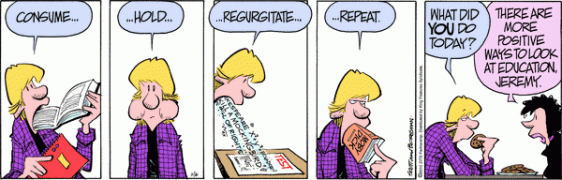
Democracy requires thoughtful, critical, independent thinkers. Citizens trained in schools only to carry out assigned tasks and regurgitate memorized bits of knowledge are not those needed to drive a democracy. A thriving democracy ought to inspire all its citizens to be civicly active, to educate themselves on society’s issues, and to regularly participate in critical discussion of the daily affairs of society. What is more, to tackle the problems and challenges of an ever changing society requires creative thinkers who do not just know past knowledge.

An alternative paradigm to the hierarchical, and authoritarian structure found in most schools is to have schools include the entire staff, along with the students and their families in making the important decisions. In such a school students experience democracy personally, and grow up immersed in a democratic rather than autocratic environment.

Just as the leader in such a school includes the participation of the staff in the school’s operation, in a democratic school the teacher includes the students’ active engagement in the decision making of the classroom. In progressive democratic classrooms, the students are involved in the planning of the classroom design, in the enactment of classroom norms, and in the management of classroom conflicts. Democratic classrooms include student voice, classroom meetings, and student-selected projects. While the teacher still retains authority in the classroom, students are given choice and opportunity over setting classroom rules and selecting project topics. By involving the students in the running of the classroom, the teacher allows students to take ownership of their learning, as well as modeling democratic culture.

The curriculum in the democratic classroom within the democratic school necessarily is democratic in both theory and practice. Democracy implies community. Community implies working together. Therefore, the democratic curriculum will involve collaborative learning where all students participate in the pursuit of a shared purpose.

Democracy, in part, includes a degree of freedom of choice and freedom of expression. Thus, students will choose many of their educational pursuits in the democratic curriculum. Student-selected projects will be important in the democratic curriculum. Projects will be of both the individual and group design, sometimes allowing for individual pursuits, and other times deferring to group collaboration.

Democracy also means having to confront controversial topics. Most schools avoid, or sometimes even prohibit, the discussion of controversial topics. Being able to discuss controversial topics is difficult. Most of what we see currently in the media is either one-sided presentations, or shouting matches. Public schools are the one place we have as a society to prepare people to actually civilly discuss their differences of viewpoints and differences.

In summary, Progressive Education, at least for me, includes student-centered curriculum that actively engages students in authentic projects and problems. It includes a democratic process of decision-making and inclusion. It includes the preparing students to confront differences with understanding and civil discourse.

Here are a few organizations that support progressive education:
The Progressive Education Network
The Coalition of Essential Schools
Association for Constructivist Teaching

To read more deeply on the meaning and History of Progressive Education:

  • Cremin, L. A. (1961). The transformation of the school; progressivism in American education, 1876-1957. New York: Knopf
  • Little, T., & Ellison, K. (2015). Loving learning: How progressive education can save America’s schools. New York: Norton.